
How to Check for a Warrant in Motley County
A Motley County warrant check starts by sorting the case by court. A JP ticket belongs with the Justice of the Peace. A Matador ordinance citation belongs with the city. Felony and district matters may run through the County Court or the 110th District Court. The county has no all-courts search box. The Motley County sheriff's page lists contacts, but no public warrant roster or status form. Have the citation, case or cause number, court name, and approximate date ready before you call. Give a birth date only if a clerk asks. Keep it out of public posts. For a serious criminal case, a lawyer can advise on the safest way to confirm status and arrange an appearance.
- Read the citation or notice and identify the issuing court.
- For a JP ticket, use the county-linked nCourt search with the citation/ticket or case/cause number.
- For a city citation, contact that city and ask for the municipal-court clerk.
- Call the County and District Clerk, JP, or sheriff for the right county record route.
- Before appearing or paying, ask the issuing court how it handles bond, hardship, recall, and written confirmation.
Motley County Has No Unified Warrant Search
Texas has no single statewide trial-court case portal. The Texas Courts FAQ says so plainly. That matters in Motley County, where the clerk, JP, city, sheriff, and federal court do not feed one public name search. The county home page links the local offices. Use the court named on the notice rather than treating one blank search as a countywide answer. The county-linked iDocket service requires an account and offers broader case and recorded-document research. It is not a warrant database. Its own accuracy limits favor the official clerk. A search can locate a case, but only the issuing court can confirm its process and the next step.
Types of Warrants in Motley County
Different case paths produce different court process in Motley County. A missed JP setting is not the same as a felony arrest warrant. A city citation does not become a county case just because it happened in Matador or Roaring Springs. Ask the issuing court for the exact document name before you act on anything.
| Warrant Type | How It Arises | Who Issues It |
|---|---|---|
| Arrest warrant | Sworn complaint and probable-cause process | Magistrate or trial court |
| Bench warrant or capias | Missed setting, judgment, or another court order | Issuing court |
| Capias pro fine | Post-judgment fine enforcement with due-process safeguards | JP or municipal court in its case |
| Family or juvenile process | Specialized child-support or juvenile matter | Authorized family or juvenile court |
Matador and Roaring Springs Warrant Routes
Motley County has two incorporated towns. Matador is the county seat; Roaring Springs is the other. A city ordinance or fine-only Class C case starts with the named city. The county JP portal is not that route. Neither town posts a public warrant lookup. A Motley County JP citation stays a JP matter even when written near either town. The JP office page links the ticket portal and posts its contact route. Each town's page notes where the public record ends.
What a Motley County Warrant Record Shows
A court record can tie the process to a cause number, offense, issuing judge, bond terms, service return, and later status entry. Motley County publishes no sample warrant. It posts no local number format either. No example number fits every case. Ask the clerk which fields appear in the actual case record.
| Cause or citation number | Identifier used by the court or JP portal; no local warrant-number format was published. |
|---|---|
| Process type | Arrest warrant, capias, capias pro fine, summons, or other court order. |
| Issuing court | The court and magistrate responsible for the process. |
| Charge or judgment | Underlying allegation, offense, fine, or court obligation, subject to access rules. |
| Bond and return | Any listed release condition and the officer’s service or execution entry. |
| Status | Ask whether the court marks it pending, served, recalled, quashed, or satisfied. |
Plan Around Motley Courthouse Hours
The county posts its public courthouse hours on weekdays. Doors open 9 a.m. to noon, then 1 p.m. to 5 p.m. That noon closure matters. Anyone driving in from a rural corner of Motley County, which covers nearly 990 square miles, should plan around it. Call ahead. Ask for the right clerk if the request concerns active process or a specific office. The official county home page lists the courthouse location and hours. It also notes that the appropriate clerk, not a vendor screen, identifies the current case route. The county page shows the posted details.
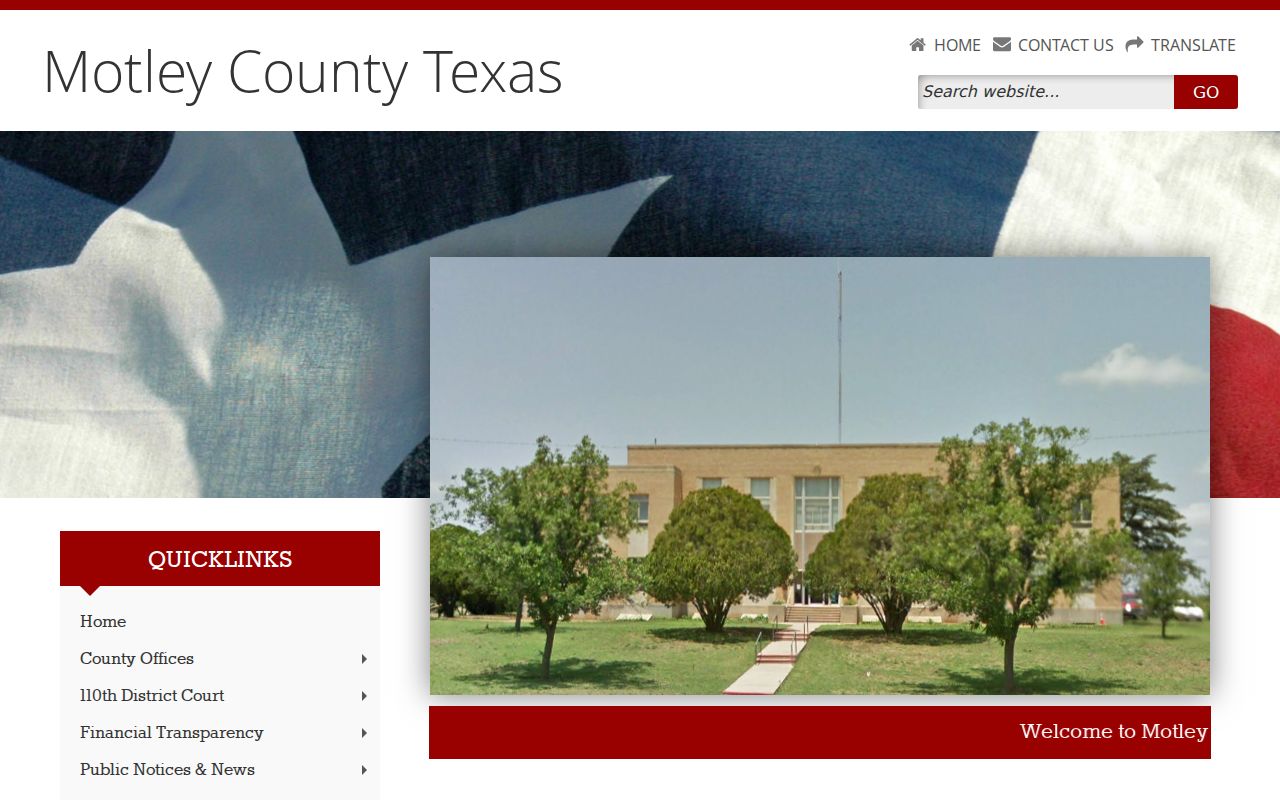
Plan any Motley County records visit around the posted hours. Confirm the right office and any counter limits before you drive.
Who Issues and Serves Motley County Warrants
Courts issue Motley County process; officers execute it. The sheriff answers service questions within the office's role. A recall, hearing, or case status rests with the issuing judge or clerk. JP and municipal matters stay in those lower courts, and serious felony work is assigned to the 110th District Court, whose office is listed in Floydada.
County and District Clerk
701 Dundee Ave
Matador, TX 79244
(806) 347-2621
No Motley County Sheriff Warrant List
The current Motley County Sheriff page lists a phone, fax, mailing address, and a general contact form. It posts no active-warrant list. There is no most-wanted roster and no warrant-status field. The form asks for contact details and a reason for inquiry. It is not an online warrant search. For a local status question, call the sheriff's office at the listed number or contact the issuing court. A Texas Public Information Act request can seek releasable records. It cannot force the county to build an all-warrants database, and a missing web listing does not establish that no Motley County warrant exists.
What to Do If You Have a Motley County Warrant
A Motley County warrant only tells you what a judge ordered, so start by finding out which court issued it and what it asks you to do. Call the right clerk. The JP or municipal clerk handles fine-only cases, and the County and District Clerk can route county or district records. On an arrest warrant or felony matter, talk to a defense lawyer before you walk in. The sheriff cannot recall a court order or promise that no arrest will happen. When you reach the court, ask about a reset, a payment plan, an ability-to-pay or hardship hearing, bond, a voluntary appearance, or a motion to recall or quash the Motley County warrant. A capias pro fine carries due-process safeguards, so paying on the spot is not your only option. Follow the court's written instructions to the letter. Keep every receipt and every order the judge signs.
Important: Get legal advice before appearing on a serious warrant; only the issuing court can confirm recall, and payment alone may not update every system.
A Payment Receipt Is Not Recall
Paying through nCourt or Certified Payments settles the money, nothing more. A receipt does not prove that a judge recalled the capias or that every law-enforcement record caught up with the payment. The JP page sends citation users to its payment service, but the case clerk is still the one who knows the real status. So keep that receipt. Call the issuing court in Motley County and ask whether a hearing, an order, or a separate recall step is still needed. If a DPS failure-to-appear or failure-to-pay hold is in play, DPS says an update can take up to seven business days after payment. That delay sits in the state license system. It is not automatic court action.
Note: Court resolution, sheriff service records, and a DPS license update can move on separate tracks, so confirm each relevant step with its own office.
Public Access to Motley County Warrant Records
Texas Government Code Chapter 552 gives the public access to records held by government bodies, though exceptions and other laws still apply. Describe an existing record in your request, such as a particular warrant, affidavit, return, docket entry, or recall order. Ask about a copy estimate and electronic delivery. The Motley County clerk's page links a public-information policy; confirm the current submission address before you send anything.
Key Rules:
Texas Government Code Chapter 552 sets public access and exceptions for existing records.
Texas courts Rule 12 policy explains court-record access and limits.
Code of Criminal Procedure Article 15.26 addresses access to executed or returned arrest warrants and affidavits, subject to other law.
Federal Warrants Follow a Separate Route
A federal warrant never runs through Motley County channels. The Northern District of Texas puts Motley County in its Lubbock Division, and the county clerk, the Justice of the Peace, nCourt, and the sheriff have no power to confirm or recall federal process. Talk to counsel or the federal clerk about a specific case. You can pull dockets yourself through PACER, though public access may involve fees. The Lubbock federal court page shows the right division location. The U.S. Marshals Service executes federal warrants. One caution applies here: a federal docket search is not a warrant index, so keep the state and federal paths straight when a notice names a court. Check which system you are actually in before you call.
Warrant Records by City in Motley County
Matador and Roaring Springs are the two incorporated towns in Motley County. A city ordinance violation or a fine-only Class C ticket starts with that town, while JP tickets stay with the county Justice of the Peace. Neither town posts a public warrant portal, and no city page here offers a warrant lookup. The city cards link out to local access notes so the two records systems stay distinct. For anything beyond that, the countywide warrant search route above is the path.
Matador Warrant Records
569 residents in the 2020 Census · City hall is the first route for city-court questions.
Roaring Springs Warrant Records
217 residents in the 2020 Census · Call city hall to ask for the current municipal-court route.